Central European School of Imagination

Invitation to participate in the Central European Summer School of Imagination 

Date: June 29 – July 2
Location: Kaprálův Mlýn, a unique site in the Moravian Karst

A summer school where food will tell stories, the voice will resonate through the landscape, and mushrooms and herbs will reveal the roots of identity.

We invite all those interested in taking part in a four-day program of the Central European Summer School of Imagination, and who wish to enter a shared space of learning, exchange, and experimentation. We welcome those who share an interest in transformative learning and open dialogue, and who are ready to engage with methods that connect intellect, emotions, the body, and local experience.

The summer school will offer an opportunity to reflect on how we can foster understanding in a divided society, how to open sensitive topics safely and creatively, and how to collectively develop approaches that help us navigate a changing world. We will share experiences, inspiration, and concrete methodologies.

About the Summer School 

At a time when the world seems fragmented by uncertainty, bubbles, and competing voices, there is a growing need to pause, listen, and rediscover ways of being and thinking together.
The summer school is an invitation into a space that makes such encounters possible. It creates a field for collectively exploring local sources of support available in Central Europe—resources that expand our capacity to engage sensitively and creatively with issues of polarization, societal crises, shifting relationships, and the possibilities of dialogue across differences.

The program combines dialogue, cooking, foraging for mushrooms and herbs, and working with place, voice, and breath.

It connects sensory work, dialogue, and a range of experiences that open space for encounters across both shared and conflicting narratives: food as a carrier of memory and Central European identity—the taste of soup, the smell of bread; voice as a bridge between body and soul, where breath physiology and subtle vocal practices build resonance and mutual understanding; mushroom foraging as a metaphor for moving through the dark forests of identity, where we may stumble upon the roots of pride or inferiority. These motifs intertwine into a single stream directed toward openness and inner integrity, enabling the safe exploration of polarization, grounding imagination in local reality, and transforming crises into growth.

For several days, Kaprálův Mlýn will become a shared space for curiosity and experience, supporting the ability to build relationships where they may seem disrupted.

Organizational Information:

Location: Kaprálův Mlýn (https://www.kapraluvmlyn.cz/) is an eco-center located in the Říčka Valley, a nature reserve in the southern part of the Drahany Highlands within the Moravian Karst Protected Landscape Area. This historic scout base offers extensive, comfortable facilities surrounded by nature—steppe meadows of Lysá hora and karst caves such as the prehistoric Pekárna Cave.

Capacity is limited to 35 participants from the Czech Republic, Slovakia, Poland, and Hungary.

The program will be conducted in English.

Facilitators: Barbora Ciprová, Tereza Čajková, Barbora Kleinhamplová, Ivana Mer, Piotr Sikora, Diana Szantó, Kateřina Vídenová, and others.

Participation in the summer school is fully funded (including accommodation, meals, and travel). A condition of participation is the ability to attend the full program.

Application deadline: May 30, 2026

How to apply?

Please fill in a short application by May 30: https://forms.gle/1grpmNC2WeezFPn5A. In your response, tell us what interests and motivates you about the topic of the Summer School. We will inform you about your participation by May 30.

Credits: visuals and graphics by Marek Meduna

@VisegradFund

The project is co-financed by the Governments of the Czechia, Hungary, Poland and Slovakia through Visegrad Grants from International Visegrad Fund . The mission of the fund is to advance ideas for sustainable regional cooperation in Central Europe.
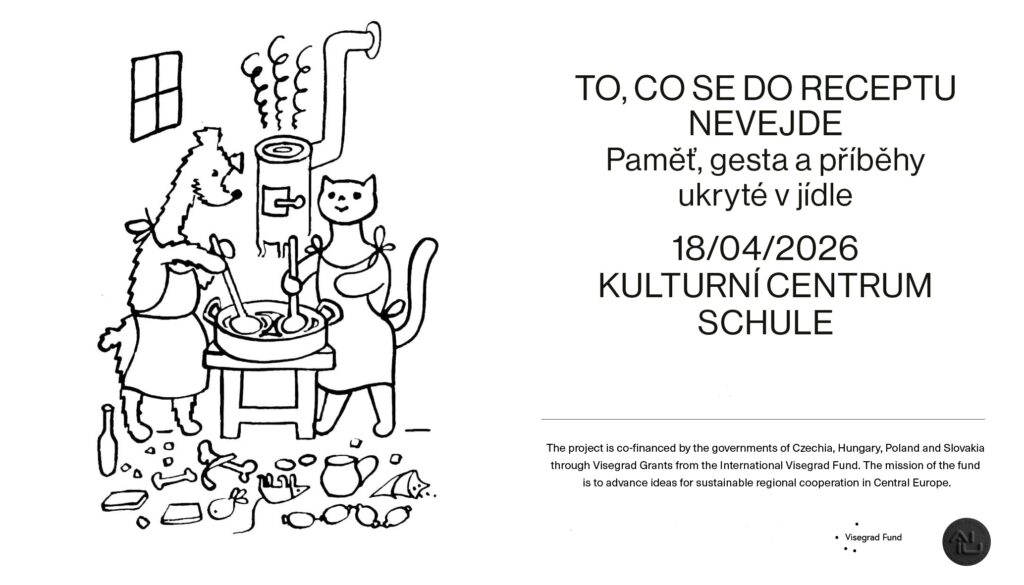
What Doesn’t Fit Into a Recipe: Memory, Gestures, and Stories Hidden in Food

What does Central European identity mean to you? Is it the taste of homemade soup, the smell of freshly baked bread, a family recipe, or a memory of the landscape? Or is it something harder to name, yet still something we carry within us? This workshop within the School of Exploring Central European Imagination creates space for shared reflection on what connects us in our region, shapes us, and sometimes also divides us.

We are looking for ways to talk about complex social issues in a sensitive, creative, and respectful way, while making space for different experiences. We are interested in how meeting across differences can strengthen understanding, relationships, and our ability to face a time full of uncertainty and change.

Come and share the stories, smells, and gestures hidden in food. This workshop will work with food as a carrier of memory, landscape, and relationships. Together, we will reflect on recipes that hold family stories, regional traditions, and everyday experience. We will share associations, memories, and symbols that come to mind in connection with our environment, and turn them into inspiration for our further joint work.

What you can look forward to:

  • Sharing and conversation about Central European identity through food, memory, and stories.
  • Jointly seeking symbols, associations, and meanings that feel close to us.
  • An accessible and informal space for meeting across different experiences.

The workshop is open to everyone who wants to take part in an open dialogue and contribute their own experience. No special knowledge is needed — just a willingness to share, listen, and think together with others.

@VisegradFund

Practical information
Date: 18 April 2026
Venue: Cultural Centre SCHULE, Šediviny 67, Kounov 518 01
Bring: one traditional recipe or a memory connected to it that means something to you

School of Exploring Central European Imagination

Today, our lives are changing in ways we could not have imagined a few years ago. In a short time we faced the global health crisis, the war in Ukraine, the cascading effects of climate crises, economic austerity and instability, social fragmentation, political polarisation, large-scale human migration, and more. In terms of polarisation and fragmentation, the National Intelligence Council (NIC) in their report “Global trends 2040. A more contested world” already in 2021 suggested that rise in populism can be expected as a consequence of narratives emphasizing the division between the elites and the masses. The NIC (2021) foresees people gravitating to “information silos” with others who share similar perspectives, bolstering their beliefs and understanding of the truth. This may result in increasingly fragmented communities as “people will seek security with like-minded groups based on established and newly prominent identities.” (NIC 2021: p.1). The fragmentation into different opinion groups, social bubbles, echo-chambers, and the associated exacerbation of positions creates a social context in which educators do not dare to raise complex topics related to divisive issues due to lack of experience in creatively working pedagogically with the problems. The annual reports of the Czech School Inspection points out that teachers are often afraid to bring up certain controversial or political topics with children, either because they divide society, or because they do not have one codified interpretation, or because they do not have the appropriate tools to do so.

Experiential formats of learning that are not primarily and only based on cognitive analysis allow us to create a pedagogical space where reflection on the above-mentioned problems can happen in more innovative ways. A pedagogical process based on a complex interconnection of the emotional, social, ethical, and physical dimensions of the topics explored can develop new cognitive and affective skills, especially if it is implemented with a focus on the development of systemic and critical thinking. This project contributes to the development of such a methodological approach by combining the long-term expertise of the participating organisations into a joint approach that will be applied across a series of seminars and one summer school and will be reflected on an online platform. The following local seminars will take place in the three V4 countries and will aim at: 1) reflecting experience with social, ecological, and political crises in the middle-European context 2) discovering sources of support for the development of socio-ecological imagination in the context of the V4 societies 3) developing possibilities for dialogue across differences and polarized societies Through participation in the seminars and the summer school and by using the online platform there will be created a disseminating network of collaborating educators. The long-term consequence of their transformed teaching practice will be reflected in the impact on learners as an increase in the development of their emancipatory and civic capacities.

List of project partners:

Artemisszió Alapítvány / Artemisszió Foundation

Fundacja Digital Creators / Digital Creators Foundation

322 o.z. / 322 civic association

The project is co-financed by the governments of Czechia, Hungary, Poland and Slovakia through Visegrad Grants from the International Visegrad Fund. The mission of the fund is to advance ideas for sustainable regional cooperation in Central Europe.